> For the complete documentation index, see [llms.txt](https://docs.hypertensor.org/llms.txt). Markdown versions of documentation pages are available by appending `.md` to page URLs; this page is available as [Markdown](https://docs.hypertensor.org/subnet-template/dht.md).
# DHT
{% hint style="success" %}
The following documentation goes over technical details on how our decentralized subnets work as a P2P network. This information is not required to [build a subnet](/build-a-subnet/introduction.md).
{% endhint %}
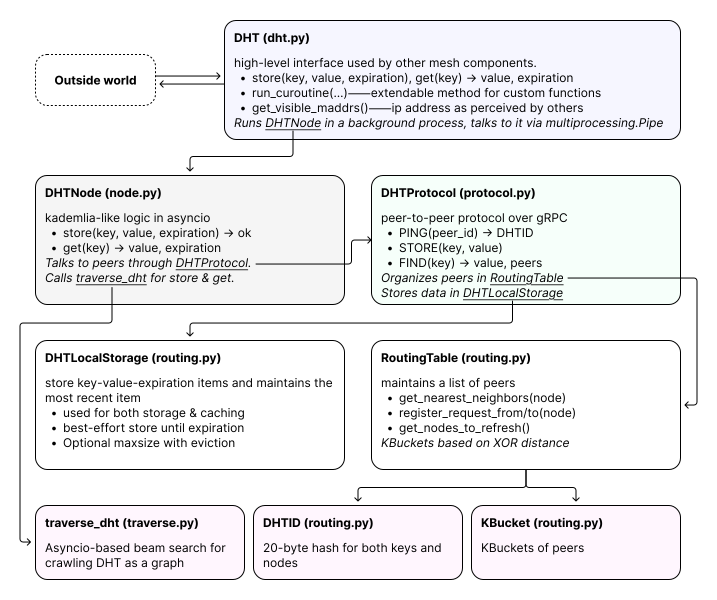
This is a Distributed Hash Table optimized for rapidly accessing a lot of lightweight metadata. The DHT is based on Kademlia \[1], with added support for improved bulk store and get operations, as well as caching.
#### The code is organized as follows:
* **class DHT** (dht.py) - high-level class for model training. Runs DHTNode in a background process.
* **class DHTNode** (node.py) - an asyncio implementation of DHT server, stores AND gets keys.
* **class DHTProtocol** (protocol.py) - an RPC protocol to request data from DHT nodes.
* **async def traverse\_dht** (traverse.py) - a search algorithm that crawls DHT peers.
## DHT and DHTNode
### DHT
#### `class dht.DHT(initial_peers: Optional[Sequence[Union[Multiaddr, str]]] = None, *, start: bool, p2p: Optional[P2P] = None, daemon: bool = True, num_workers: int = 4, record_validators: Iterable[RecordValidatorBase] = (), shutdown_timeout: float = 3, await_ready: bool = True, **kwargs)`
* A high-level interface to the DHT that runs a single DHT node in a background process.
#### Parameters
* **initial\_peers** – multiaddrs of one or more active DHT peers (if you want to join an existing DHT)
* **start** – if True, automatically starts the background process on creation. Otherwise, await manual start
* **daemon** – if True, the background process is marked as a daemon and automatically terminated after the main process
* **num\_workers** – declare\_experts and get\_experts will use up to this many parallel workers (but no more than one per key)
* **expiration** – node declared that this node expires after this many seconds (default = 5 minutes)
* **record\_validators** – instances of RecordValidatorBase used for signing and validating stored records. The validators will be combined using the CompositeValidator class. It merges them when possible (according to their *.merge\_with()* policies) and orders them according to the *.priority* properties.
* **shutdown\_timeout** – when calling shutdown, wait for up to this many seconds before terminating
* **await\_ready** – if True, the constructor waits until the DHT process is ready to process incoming requests
* **kwargs** – any other params will be forwarded to DHTNode and p2p.P2P upon creation
***
#### `run()→ None`
* Serve DHT forever. This function will not return until the DHT node is shut down
***
#### `run_in_background(await_ready: bool = True, timeout: Optional[float] = None)→ None`
* Starts DHT in a background process. If await\_ready, this method will wait until the background DHT is ready to process incoming requests or for :timeout: seconds max.
***
#### `shutdown()→ None`
* Shut down a running DHT process
***
#### `get(key: Any, latest: bool = False, return_future: bool = False, **kwargs)→ Union[ValueWithExpiration[Any], None, MPFuture]`
* Search for a key across DHT and return either the first or the latest entry (if found). :param key: same key as in node.store(…) :param latest: if True, finds the latest value, otherwise finds any non-expired value (which is much faster) :param return\_future: if False (default), return when finished. Otherwise, return MPFuture and run inthe background. :param kwargs: parameters forwarded to DHTNode.get\_many\_by\_id :returns: (value, expiration time); if value was not found, returns None.
***
#### `store(key: Any, value: Any, expiration_time: float, subkey: Optional[Any] = None, return_future: bool = False, **kwargs)→ Union[bool, MPFuture]`
* Find the num\_replicas best nodes to store (key, value) and store it there until the expiration time.
#### Parameters
* **key** – msgpack-serializable key to be associated with value until expiration.
* **value** – msgpack-serializable value to be stored under a given key until expiration.
* **expiration\_time** – absolute time when the entry should expire, based on get\_dht\_time()
* **subkey** – if specified, add a value under that subkey instead of overwriting the key (see DHTNode.store\_many)
* **return\_future** – if False (default), return when finished. Otherwise, return MPFuture and run in the background.
#### Returns
True if the store succeeds, False if it fails (due to no response or newer value)
***
#### `run_coroutine(coro: Callable[[DHT, DHTNode], Awaitable[ReturnType]], return_future: bool = False)→ Union[ReturnType, MPFuture[ReturnType]].`
* Execute an asynchronous function on a DHT participant and return results. This is meant as an interface for running custom functions DHT for special cases (e.g., declare nodes)
#### Parameters
* **coro** – async function to be executed. Receives 2 arguments: this DHT daemon and a running DHTNode
* **return\_future** – if False (default), return when finished. Otherwise, return MPFuture and run in the background.
#### Returns
coroutine outputs or MPFuture for these outputs
#### Note
The coroutine will be executed inside the DHT process. As such, any changes to global variables or DHT fields made by this coroutine will not be accessible from the host process.
#### Note
All time-consuming operations in coro should be asynchronous (e.g. `asyncio.sleep` instead of `time.sleep`) or use `asyncio.get_event_loop().run_in_executor(…)` to prevent the coroutine from blocking background DHT tasks
#### Note
When `run_coroutine` is called with return\_future=False, MPFuture can be cancelled to interrupt the task.
***
#### `get_visible_maddrs(latest: bool = False)→ List[Multiaddr]`
Get the multiaddrs of the current DHT node that should be accessible by other peers.
Parameters
**latest** – ask the P2P daemon to refresh the visible multiaddrs
***
#### `async replicate_p2p()→ P2P`
Get a replica of a P2P instance used in the DHT process internally. The replica uses the same P2P daemon as the DHT and only works while the DHT is alive.
***
### DHTNode
#### `class dht.DHTNode(*, _initialized_with_create=False)`
Asyncio-based class that represents one DHT participant. Created via await `DHTNode.create(…)`. Each `DHTNode` has an identifier, local storage, and access to other nodes via `DHTProtocol`.
#### Note
The DHT is optimized to store a lot of temporary metadata that is regularly updated. For example, a node heartbeat is emitted by a Server responsible for that node. Such metadata does not require regular maintenance by peers or persistence on shutdown. Instead, DHTNode is designed to rapidly send bulk data and resolve conflicts.
***
Every (key, value) pair in this DHT has an expiration time-float computed as `get_dht_time()` (UnixTime by default). DHT nodes always prefer values with higher expiration times and may delete any value past its expiration.
#### Similar to the Kademlia RPC protocol, DHT has 3 RPCs:
* **`ping`** - Request peer’s identifier and update routing table (same as Kademlia PING RPC)
* **`store`** - Send several (key, value, expiration\_time) pairs to the same peer (like Kademlia STORE, but in bulk)
* **`find`** - Request one or several keys, get values and expiration (if peer finds it locally), and :bucket\_size: of
nearest peers from the recipient’s routing table (ordered nearest-to-farthest, not including the recipient itself). This RPC is a mixture between Kademlia FIND\_NODE and FIND\_VALUE with multiple keys per call.
#### A DHTNode follows the following contract:
* When asked to get(key), a node must find and return a value with the highest expiration time that it found across DHT, IF that time has not come yet. if expiration time is smaller than current get\_dht\_time(), node may return None;
* When requested to store(key: value, expiration\_time), a node must store (key => value) until expiration time or until DHTNode gets the same key with a greater expiration time. If a node is asked to store a key but it already has the same key with a newer expiration, `store` will be rejected. Store returns True if accepted, False if rejected;
* when requested to store(key: value, expiration\_time, subkey=subkey), adds a sub-key to a dictionary value type. Dictionary values can have multiple subkeys stored by different peers with individual expiration times. A subkey will be accepted into a dictionary if there is no such subkey or if the new subkey’s expiration is later than the previous expiration under that subkey. See `DHTProtocol.call_store` for details.
#### DHTNode also features several (optional) caching policies:
* **`cache_locally`** - After GET, store the result in the node’s local cache
* **`cache_nearest` -** After GET, send the result to this many nearest nodes that don’t have that value yet (see Kademlia)
* **`cache_on_store`**- After STORE, either save or remove that key from the node’s cache, depending on the store status
* **`cache_refresh_before_expiry`**- If a value in the cache was used and is about to expire, try to GET it this many seconds before expiration. The motivation here is that some frequent keys should always be kept in cache to avoid latency.
* **`reuse_get_requests`**- If there are several concurrent GET requests, when one request finishes, DHTNode will attempt to reuse the result of this GET request for other requests with the same key. Useful for batch-parallel requests.
***
#### `async classmethod create(p2p: Optional[P2P] = None, node_id: Optional[DHTID] = None, initial_peers: Optional[Sequence[Union[Multiaddr, str]]] = None, bucket_size: int = 20, num_replicas: int = 5, depth_modulo: int = 5, parallel_rpc: int = None, wait_timeout: float = 3, refresh_timeout: Optional[float] = None, bootstrap_timeout: Optional[float] = None, cache_locally: bool = True, cache_nearest: int = 1, cache_size=None, cache_refresh_before_expiry: float = 5, cache_on_store: bool = True, reuse_get_requests: bool = True, num_workers: int = 4, chunk_size: int = 16, blacklist_time: float = 5.0, backoff_rate: float = 2.0, client_mode: bool = False, record_validator: Optional[RecordValidatorBase] = None, authorizer: Optional[AuthorizerBase] = None, ensure_bootstrap_success: bool = True, strict: bool = True, **kwargs)→ DHTNode`
#### Parameters
* **p2p** – instance of p2p.P2P that will be used for communication. If None, DHTNode will create and manage its own P2P instance with given initial\_peers and parameters from `kwargs`
* **node\_id** – current node’s DHTID for the DHT, determines which keys it will store locally, defaults to a random ID
* **initial\_peers** – multiaddrs of one or more active DHT peers (if you want to join an existing DHT)
* **bucket\_size** – max number of nodes in one k-bucket (k). Trying to add {k+1}st node will cause a bucket to either split into two buckets along the midpoint or reject the new node (but still save it as a replacement). Recommended value: k is chosen s.t. any given k nodes are very unlikely to all fail after staleness\_timeout
* **num\_replicas** – number of nearest nodes that will be asked to store a given key, default = bucket\_size (≈k)
* **depth\_modulo** – split full k-bucket if it contains root OR up to the nearest multiple of this value (≈b)
* **parallel\_rpc** – maximum number of concurrent outgoing RPC requests emitted by DHTProtocol. Reduce this value if your RPC requests register no response despite the peer sending the response.
* **wait\_timeout** – a Kademlia RPC request is deemed lost if we do not receive a reply within this many seconds
* **refresh\_timeout** – refresh buckets if no node from that bucket was updated in this many seconds if staleness\_timeout is None, DHTNode will not refresh stale buckets (which is usually okay)
* **bootstrap\_timeout** – after one of the peers responds, await the other peers for at most this many seconds
* **cache\_locally** – if True, caches all values (stored or found) in a node-local cache
* **cache\_on\_store** – if True, update cache entries for a key after storing a new item for that key
* **cache\_nearest** – whenever DHTNode finds a value, it will also store (cache) this value on this many nearest nodes visited by the search algorithm. Prefers nodes that are nearest to :key: but have no value yet
* **cache\_size** – if specified, local cache will store up to this many records (as in LRU cache)
* **cache\_refresh\_before\_expiry** – if nonzero, refreshes locally cached values if they are accessed this many seconds before expiration time.
* **reuse\_get\_requests** – if True, DHTNode allows only one traverse\_dht procedure for every key all concurrent get requests for the same key will reuse the procedure that is currently in progress
* **num\_workers** – concurrent workers in traverse\_dht (see traverse\_dht num\_workers param)
* **chunk\_size** – maximum number of concurrent calls in get\_many and cache refresh queue
* **blacklist\_time** – excludes non-responsive peers from search for this many seconds (set 0 to disable)
* **backoff\_rate** – blacklist time will be multiplied by :backoff\_rate: for each successive non-response
* **ensure\_bootstrap\_success** – raise an error if node could not connect to initial peers (or vice versa) If False, print a warning instead. It is recommended to keep this flag unless you know what you’re doing.
* **strict** – if True, any error encountered in validation will interrupt the creation of DHTNode
* **client\_mode** – if False (default), this node will accept incoming requests as a full DHT “citizen” if True, this node will refuse any incoming requests, effectively being only a client
* **record\_validator** – instance of RecordValidatorBase used for signing and validating stored records
* **authorizer** – instance of AuthorizerBase used for signing and validating requests and responses for a given authorization protocol
* **kwargs** – extra parameters for an internally created instance of p2p.P2P. Should be empty if the P2P instance is provided in the constructor
***
#### `async shutdown()`
* Process existing requests, close all connections, and stop the server
***
#### `async find_nearest_nodes(queries: Collection[DHTID], k_nearest: Optional[int] = None, beam_size: Optional[int] = None, num_workers: Optional[int] = None, node_to_peer_id: Optional[Dict[DHTID, PeerID]] = None, exclude_self: bool = False, **kwargs)→ Dict[DHTID, Dict[DHTID, PeerID]]`
#### Parameters
* **queries** – find k nearest nodes for each of these DHTIDs
* **k\_nearest** – return this many nearest nodes for every query (if there are enough nodes)
* **beam\_size** – replacement for self.beam\_size, see traverse\_dht beam\_size param
* **num\_workers** – replacement for self.num\_workers, see traverse\_dht num\_workers param
* **node\_to\_peer\_id** – if specified, uses this dict\[node\_id => peer\_id] as initial peers
* **exclude\_self** – if True, nearest nodes will not contain self.node\_id (default = use local peers)
* **kwargs** – additional params passed to traverse\_dht
#### Returns
for every query, return nearest peers ordered dict\[peer DHTID -> network PeerID], nearest-first
***
#### `async store(key: Any, value: Any, expiration_time: float, subkey: Optional[Any] = None, **kwargs)→ bool`
Find the num\_replicas best nodes to store (key, value) and store it there at least until the expiration time. :note: store is a simplified interface to store\_many, all kwargs are forwarded there :returns: True if store succeeds, False if it fails (due to no response or newer value)
***
#### `async store_many(keys: List[Any], values: List[Any], expiration_time: Union[float, List[float]], subkeys: Optional[Union[Any, List[Optional[Any]]]] = None, exclude_self: bool = False, await_all_replicas=True, **kwargs)→ Dict[Any, bool]`
Traverse DHT to find up :num\_replicas: to the best nodes to store multiple (key, value, expiration\_time) pairs.
Parameters
* **keys** – arbitrary serializable keys associated with each value
* **values** – serializable “payload” for each key
* **expiration\_time** – either one expiration time for all keys or individual expiration times (see class doc)
* **subkeys** – an optional list of the same shape as keys. If specified, this
* **kwargs** – any additional parameters passed to `traverse_dht` function (e.g., num workers)
* **exclude\_self** – if True, never store value locally, even if you are one of the nearest nodes
* **await\_all\_replicas** – if False, this function returns after the first store\_ok and proceeds in the background if True, the function will wait for num\_replicas successful stores or running out of beam\_size nodes
Note
If exclude\_self is True and self.cache\_locally == True, value will still be \_\_cached\_\_ locally
Returns
for each key: True if store succeeds, False if it fails (due to no response or newer value)
***
#### `async get(key: Any, latest=False, **kwargs)→ Optional[ValueWithExpiration[Any]]`
* Search for a key across DHT and return either the first or the latest entry (if found). :param key: same key as in `node.store(…)` :param latest: if True, finds the latest value, otherwise finds any non-expired value (which is much faster) :param kwargs: parameters forwarded to get\_many\_by\_id :returns: (value, expiration time); if value was not found, returns None.
***
#### `asyncget_many(keys: Collection[Any], sufficient_expiration_time: Optional[float] = None, **kwargs)→ Dict[Any, Union[ValueWithExpiration[Any], None, Awaitable[Optional[ValueWithExpiration[Any]]]]]`
* Traverse DHT to find a list of keys. For each key, return the latest (value, expiration) or None if not found.
#### Parameters
* **keys** – traverse the DHT and find the value for each of these keys (or (None, None) if not key found)
* **sufficient\_expiration\_time** – if the search finds a value that expires after this time, default = time of call, find any value that did not expire by the time of call If min\_expiration\_time=float(‘inf’), this method will find a value with \_latest\_ expiration
* **kwargs** – for full list of parameters, see DHTNode.get\_many\_by\_id
#### Returns
for each key: value and its expiration time. If nothing is found, returns (None, None) for that key
#### Note
To check if get returns a value, please check if (expiration\_time is None)
***
#### `async get_many_by_id(key_ids: Collection[DHTID], sufficient_expiration_time: Optional[float] = None, num_workers: Optional[int] = None, beam_size: Optional[int] = None, return_futures: bool = False, _is_refresh=False)→ Dict[DHTID, Union[ValueWithExpiration[Any], None, Awaitable[Optional[ValueWithExpiration[Any]]]]]`
* Traverse DHT to find a list of DHTIDs. For each key, return the latest (value, expiration) or None if not found.
#### Parameters
* **key\_ids** – traverse the DHT and find the value for each of these keys (or (None, None) if not key found)
* **sufficient\_expiration\_time** – if the search finds a value that expires after this time, default = time of call, find any value that did not expire by the time of call If min\_expiration\_time=float(‘inf’), this method will find a value with \_latest\_ expiration
* **beam\_size** – maintains up to this many nearest nodes when crawling DHT, default beam\_size = bucket\_size
* **num\_workers** – override for default num\_workers, see traverse\_dht num\_workers param
* **return\_futures** – if True, immediately return `asyncio.Future` before interacting with the network. The algorithm will populate these futures with (value, expiration) when it finds the corresponding key.
* **Note**: canceling a future will stop the search for the corresponding key
* **\_is\_refresh** – internal flag, set to True by an internal cache refresher (if enabled)
#### Returns
for each key: value and its expiration time. If nothing is found, returns (None, None) for that key.
#### Note
To check if get returns a value, please check if (expiration\_time is None).
***
## DHT communication protocol
### DHTProtocol
An RPC protocol that provides nodes with a way to communicate with each other
#### `class dht.protocol.DHTProtocol(*, _initialized_with_create=False)`
#### serializer
* alias of `MSGPackSerializer`
***
#### `async classmethod create(p2p: P2P, node_id: DHTID, bucket_size: int, depth_modulo: int, num_replicas: int, wait_timeout: float, parallel_rpc: Optional[int] = None, cache_size: Optional[int] = None, client_mode: bool = False, record_validator: Optional[RecordValidatorBase] = None, authorizer: Optional[AuthorizerBase] = None)→ DHTProtocol`
A protocol that allows DHT nodes to request keys/neighbors from other DHT nodes. As a side-effect, DHTProtocol also maintains a routing table as described in
{% hint style="info" %}
See DHTNode (node.py) for a more detailed description.
{% endhint %}
#### Note
The `rpc_*` methods defined in this class will be automatically exposed to other DHT nodes. For instance, `def rpc_ping` can be called as `protocol.call_ping(peer_id, dht_id)` from a remote machine. Only the `call_*` methods are meant to be called publicly, e.g., from DHTNode
**Read more:**
***
#### `get_stub(peer: PeerID)→ AuthRPCWrapper`
* Get a stub that sends requests to a given peer
***
#### `async call_ping(peer: PeerID, validate: bool = False, strict: bool = True)→ Optional[DHTID]`
Get peer’s node ID and add him to the routing table. If peer doesn’t respond, return None :param peer: peer ID to ping :param validate: if True, validates that node’s peer\_id is available :param strict: if strict=True, validation will raise exception on fail, otherwise it will only warn :note: if DHTProtocol was created with client\_mode=False, also request peer to add you to his routing table
#### Returns
node’s DHTID, if the peer responded and decided to send its node ID.
***
#### `async rpc_ping(request: PingRequest, context: P2PContext)→ PingResponse`
Some node wants us to add it to our routing table.
***
#### `async call_store(peer: PeerID, keys: Sequence[DHTID], values: Sequence[Union[bytes, DictionaryDHTValue]], expiration_time: Union[float, Sequence[float]], subkeys: Optional[Union[Any, Sequence[Optional[Any]]]] = None, in_cache: Optional[Union[bool, Sequence[bool]]] = None)→ Optional[List[bool]]`
Ask a recipient to store several (key, value : expiration\_time) items or update their older value
Parameters
* **peer** – request this peer to store the data
* **keys** – a list of N keys digested by DHTID.generate(source=some\_dict\_key)
* **values** – a list of N serialized values (bytes) for each respective key
* **expiration\_time** – a list of N expiration timestamps for each respective key-value pair(see get\_dht\_time())
* **subkeys** – a list of N optional subkeys. If None, stores value normally. If not subkey is not None: 1) if local storage doesn’t have :key:, create a new dictionary {subkey: (value, expiration\_time)} 2) if local storage already has a dictionary under :key:, try add (subkey, value, exp\_time) to that dictionary 2) if local storage associates :key: with a normal value with smaller expiration, clear :key: and perform (1) 3) finally, if local storage currently associates :key: with a normal value with larger expiration, do nothing
* **in\_cache** – a list of booleans, True = store i-th key in cache, value = store i-th key locally
#### Note
The difference between storing normally and in cache is that normal storage is guaranteed to be stored until expiration time (best-effort), whereas cached storage can be evicted early due to limited cache size
#### Returns
list of \[True / False] True = stored, False = failed (found newer value or no response) if peer did not respond (e.g., due to timeout or congestion), returns None
***
#### `async rpc_store(request: StoreRequest, context: P2PContext)→ StoreResponse`
Some node wants us to store this (key, value) pair
***
#### `async call_find(peer: PeerID, keys: Collection[DHTID])→ Optional[Dict[DHTID, Tuple[Optional[ValueWithExpiration[Union[bytes, DictionaryDHTValue]]], Dict[DHTID, PeerID]]]]`
Request keys from a peer. For each key, look for its (value, expiration time) locally and k additional peers that are most likely to have this key (ranked by XOR distance)
#### Returns
A dict key => Tuple\[optional value, optional expiration time, nearest neighbors] value: value stored by the recipient with that key, or None if peer doesn’t have this value expiration time: expiration time of the returned value, None if no value was found neighbors: a dictionary\[node\_id : peer\_id] containing nearest neighbors from peer’s routing table If peer didn’t respond, returns None
***
#### `async rpc_find(request: FindRequest, context: P2PContext)→ FindResponse`
Someone wants to find the keys in the DHT. For all keys that we have locally, return value and expiration. Also return :bucket\_size: nearest neighbors from our routing table for each key (whether or not we found a value)
***
#### `async update_routing_table(node_id: Optional[DHTID], peer_id: PeerID, responded=True)`
This method is called on every incoming AND outgoing request to update the routing table
Parameters
* **peer\_id** – sender peer\_id for incoming requests, recipient peer\_id for outgoing requests
* **node\_id** – sender node ID for incoming requests, recipient node ID for outgoing requests
* **responded** – for outgoing requests, this indicated whether the recipient responded or not. For incoming requests, this should always be True
***
### Routing Tables
A data structure that contains DHT peers bucketed according to their distance to node\_id. Follows Kademlia routing table as described in .
#### Parameters
* **node\_id** – node ID used to measure distance
* **bucket\_size** – parameter $k$ from Kademlia paper Section 2.2
* **depth\_modulo** – parameter $b$ from Kademlia paper Section 2.2.
#### Note
You can find a more detailed description of parameters in DHTNode, see node.py.
***
#### `get_bucket_index(node_id: DHTID)→ int`
Get the index of the bucket that the given node would fall into.
***
#### `add_or_update_node(node_id: DHTID, peer_id: PeerID)→ Optional[Tuple[DHTID, PeerID]]`
Update the routing table after an incoming request from :peer\_id: or an outgoing request to :peer\_id:
#### Returns
If we cannot add node\_id to the routing table, return the least-recently-updated node (Section 2.2)
#### Note
DHTProtocol calls this method for every incoming and outgoing request if there is a response. If this method returned a node to be pinged, the protocol will ping it to check and either move it to the start of the table or remove that node and replace it with.
***
#### `split_bucket(index: int)→ None`
Split the bucket range into two equal parts and reassign nodes to the appropriate half.
***
#### `get(*, node_id: Optional[DHTID] = None, peer_id: Optional[PeerID] = None, default=None)`
Find peer\_id for a given DHTID or vice versa.
***
#### `get_nearest_neighbors(query_id: DHTID, k: int, exclude: Optional[DHTID] = None)→ List[Tuple[DHTID, PeerID]]`
Find k nearest neighbors from the routing table according to XOR distance, does NOT include self.node\_id
#### Parameters
* **query\_id** – find neighbors of this node
* **k** – Find this many neighbors. If there aren’t enough nodes in the table, it returns all nodes
* **exclude** – if True, results will not contain query\_node\_id even if it is in the table
#### Returns
a list of tuples (node\_id, peer\_id) for up to k neighbors, sorted from nearest to farthest
***
#### KBucket
#### `class dht.routing.KBucket(lower: int, upper: int, size: int, depth: int = 0)`
A bucket containing up to :size: of DHTIDs in \[lower, upper) semi-interval. Maps DHT node IDs to their peer IDs
***
#### `has_in_range(node_id: DHTID)`
Check if node\_id is between this bucket’s lower and upper bounds
***
#### `add_or_update_node(node_id: DHTID, peer_id: PeerID)→ bool`
Add node to KBucket or update existing node, return True if successful, False if the bucket is full. If the bucket is full, keep track of the node in a replacement list, per section 4.1 of the paper.
#### Parameters
* **node\_id** – dht node identifier that should be added or moved to the front of the bucket
* **peer\_id** – network address associated with that node ID
#### Note
This function has a side-effect of resetting KBucket.last\_updated time.
***
#### `request_ping_node()→ Optional[Tuple[DHTID, PeerID]]`
#### Returns
least-recently updated node that isn’t already being pinged right now – if such a node exists.
***
#### `split()→ Tuple[KBucket, KBucket]`
Split bucket over midpoint, rounded down, assign nodes according to their ID.
***
#### DHTID
#### `class dht.routing.DHTID(value: int)`
#### `classmethod generate(source: Optional[Any] = None, nbits: int = 255)`
Generates a random UID based on SHA1.
#### Parameters
**source** – if provided, converts this value to bytes and uses it as input for the hashing function; by default, generates a random dhtid from :nbits: random bits.
***
#### `xor_distance(other: Union[DHTID, Sequence[DHTID]])→ Union[int, List[int]]`
#### Parameters
**other** – one or multiple DHTIDs. If given multiple DHTIDs as other, this function will compute distance from self to each of the DHTIDs in other.
#### Returns
a number or a list of numbers whose binary representations equal the bitwise XOR between DHTIDs.
***
#### `to_bytes(length=20, byteorder='big', *, signed=False)→ bytes`
A standard way to serialize DHTID into bytes.
***
#### `classmethod from_bytes(raw: bytes, byteorder='big', *, signed=False)→ DHTID`
The reverse of to\_bytes.
***
## Traverse (crawl) DHT
Utility functions for crawling DHT nodes, used to get and store keys in a DHT.
#### `async dht.traverse.simple_traverse_dht(query_id: DHTID, initial_nodes: Collection[DHTID], beam_size: int, get_neighbors: Callable[[DHTID], Awaitable[Tuple[Collection[DHTID], bool]]], visited_nodes: Collection[DHTID] = ())→ Tuple[Tuple[DHTID], Set[DHTID]]`
Traverse the DHT graph using the `get_neighbors` function, find :beam\_size: nearest nodes according to DHTID.xor\_distance.
#### Note
This is a simplified (but working) algorithm provided for documentation purposes. Actual DHTNode uses *traverse\_dht* - a generalization of this algorithm that allows multiple queries and concurrent workers.
#### Parameters
* **query\_id** – search query, find k\_nearest neighbors of this DHTID
* **initial\_nodes** – nodes used to pre-populate beam search heap, e.g., \[my\_own\_DHTID, …maybe\_some\_peers]
* **beam\_size** – beam search will not give up until it exhausts this many nearest nodes (to query\_id) from the heap. Recommended value: A beam size of k\_nearest \* (2-5) will yield near-perfect results.
* **get\_neighbors** – A function that returns neighbors of a given node and controls beam search stopping criteria. async def get\_neighbors(node: DHTID) -> neighbors\_of\_that\_node: List\[DHTID], should\_continue: bool If should\_continue is False, beam search will halt and return k\_nearest of whatever it found by then.
* **visited\_nodes** – beam search will neither call get\_neighbors on these nodes, nor return them as nearest
#### Returns
a list of k nearest nodes (nearest to farthest), and a set of all visited nodes (including visited\_nodes)
***
#### `async dht.traverse.traverse_dht(queries: Collection[DHTID], initial_nodes: List[DHTID], beam_size: int, num_workers: int, queries_per_call: int, get_neighbors: Callable[[DHTID, Collection[DHTID]], Awaitable[Dict[DHTID, Tuple[Tuple[DHTID], bool]]]], found_callback: Optional[Callable[[DHTID, List[DHTID], Set[DHTID]], Awaitable[Any]]] = None, await_all_tasks: bool = True, visited_nodes: Optional[Dict[DHTID, Set[DHTID]]] = ())→ Tuple[Dict[DHTID, List[DHTID]], Dict[DHTID, Set[DHTID]]]`
Search the DHT for nearest neighbors to :queries: (based on DHTID.xor\_distance). Use get\_neighbors to request peers. The algorithm can reuse intermediate results from each query to speed up the search for other (similar) queries.
#### Parameters
* **queries** – a list of search queries, find beam\_size neighbors for these DHTIDs
* **initial\_nodes** – nodes used to pre-populate beam search heap, e.g., \[my\_own\_DHTID, …maybe\_some\_peers]
* **beam\_size** – beam search will not give up until it visits this many nearest nodes (to query\_id) from the heap
* **num\_workers** – run up to this many concurrent get\_neighbors requests, each querying one peer for neighbors. When selecting a peer to request neighbors from, workers try to balance concurrent exploration across queries. A worker will expand the nearest candidate to a query with the least concurrent requests from other workers. If several queries have the same number of concurrent requests, prefer the one with the nearest XOR distance.
* **queries\_per\_call** – workers can pack up to this many queries in one get\_neighbors call. These queries contain the primary query (see num\_workers above) and up to *queries\_per\_call - 1* nearest unfinished queries.
* **get\_neighbors** – A function that requests a given peer to find nearest neighbors for multiple queries async def get\_neighbors(peer, queries) -> {query1: (\[nearest1, nearest2, …], False), query2: (\[…], True)} For each query in queries, return nearest neighbors (known to a given peer) and a boolean “should\_stop” flag If should\_stop is True, traverse\_dht will no longer search for this query or request it from other peers. The search terminates if each query is either stopped via should\_stop or finds beam\_size nearest nodes.
* **found\_callback** – if specified, call this callback for each finished query the moment it finishes or is stopped. More specifically, run asyncio.create\_task(found\_callback(query, nearest\_to\_query, visited\_for\_query)). Using this callback allows one to process results faster before traverse\_dht is finishes for all queries. It is guaranteed that found\_callback will be called exactly once on each query in queries.
* **await\_all\_tasks** – if True, wait for all tasks to finish before returning, otherwise returns after finding nearest neighbors and finishes the remaining tasks (callbacks and queries to known-but-unvisited nodes)
* **visited\_nodes** – for each query, do not call get\_neighbors on these nodes, nor return them among the nearest.
#### Note
The source code of this function can get tricky to read. Take a look at the *`simple_traverse_dht`* function for reference. That function implements a special case of traverse\_dht with a single query and one worker.
#### Returns
a dict of nearest nodes, and another dict of visited nodes nearest nodes: { query -> a list of up to beam\_size nearest nodes, ordered nearest-first } visited nodes: { query -> a set of all nodes that received requests for a given query }